

Norstella recently spoke with the Wall Street Journal’s Brian Gormley in a feature article: Biotech VC’s Vaccine Die-Hards. The piece explores how investment has pivoted away from vaccines, leaving a select group of committed developers to carry the flag. Strides made during the pandemic mean that a decade or more of progress was condensed into a couple of years. But this cycle has ended, leaving a sharp drop in financing and new candidates entering the pipeline, reverting the landscape back to a baseline set during the 2010s.
Venture investment has fallen sharply
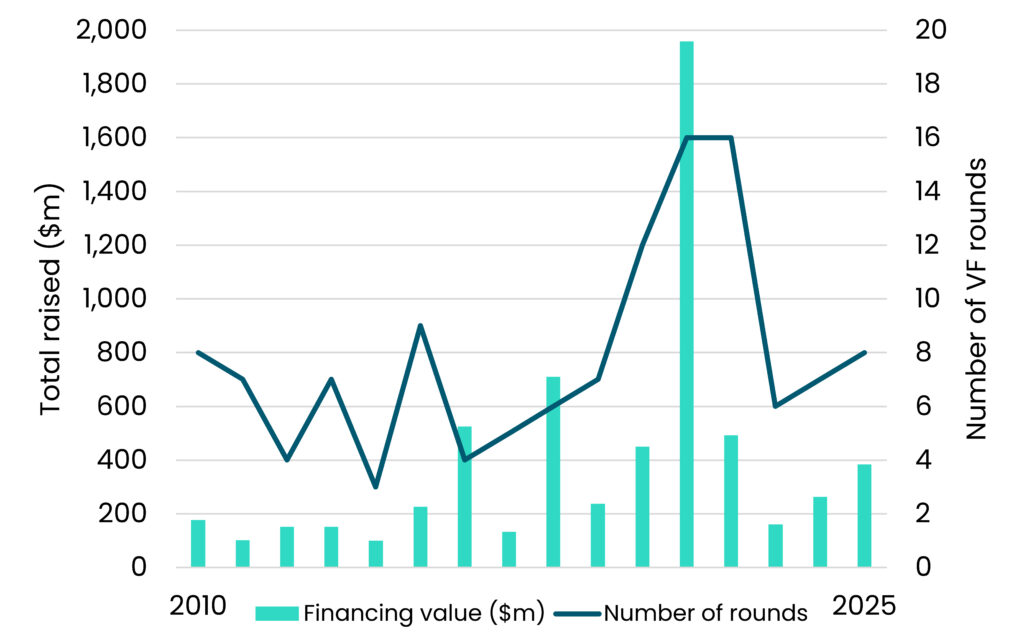
From a peak of $2bn across 16 venture capital financing rounds in 2021, eight biotechs raised just shy of $400m during 2025. And just one of these rounds belonged to a US developer, where the appetite for investing in novel vaccines has fallen considerably.
This downward trend in venture financing has been seen in other therapy areas, although the steepness of this drop-off is unique to the vaccines space. Early-stage investors are preferring higher growth opportunities with a greater potential for an exit via M&A, leading to more resilience in areas such as oncology, immunology, and cardiometabolic diseases.
Venture financing for vaccine biotechs
Source: Biomedtracker, Evaluate
Pipeline creation is down and shifting eastwards
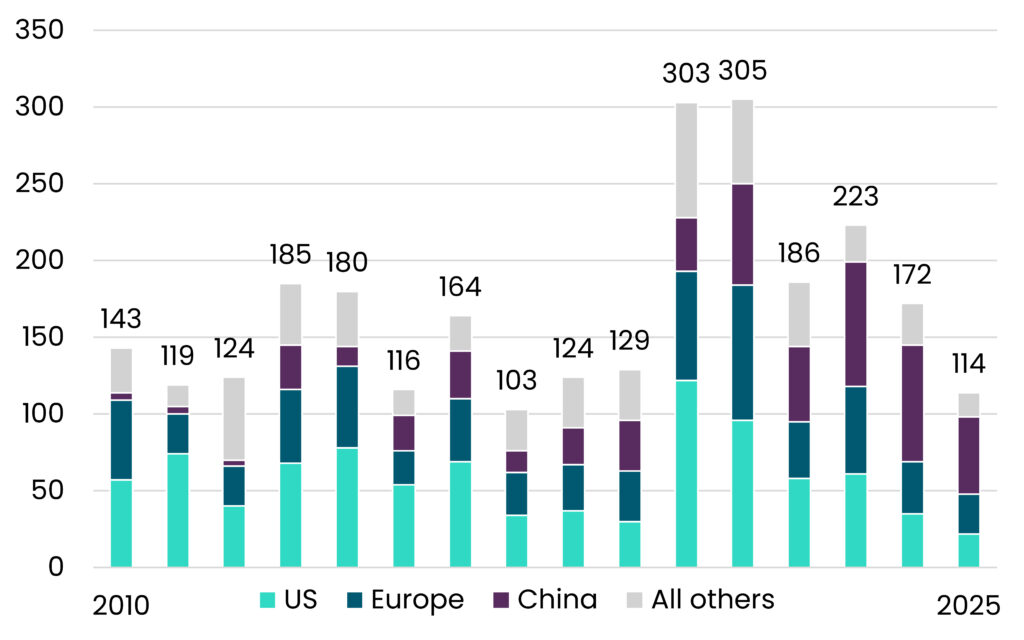
The rate at which new vaccines are entering the pipeline has also fallen considerably. According to data from Citeline, 114 novel vaccine candidates were discovered and progressed into preclinical or clinical development during 2025. This continues the downward trend from 2020 and 2021 when over 300 new vaccines were disclosed.
While 2025 is now broadly at levels seen during the 2010s, the origin of these vaccines is now dramatically changed. Biotechs based in China are now the source of around 40% of these new vaccines, while US and European companies each possess a 20% share.
New anti-infective vaccines entering the pipeline
Source: Pharmaprojects, Citeline