
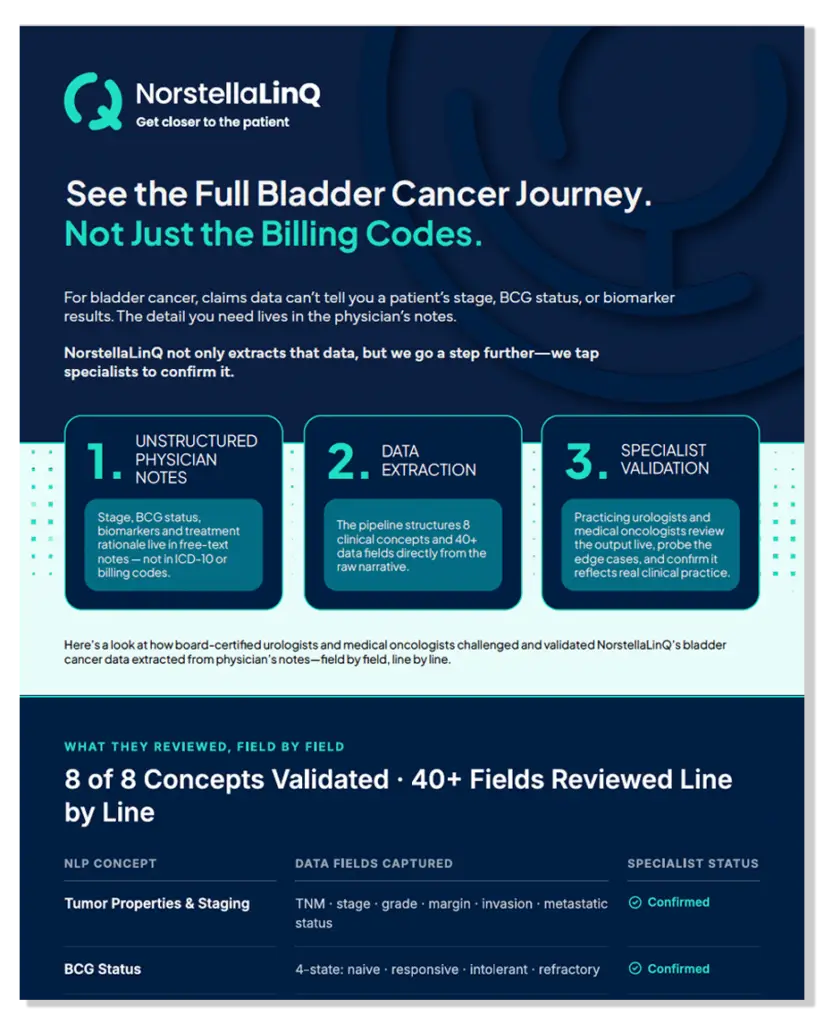
See the Full Bladder Cancer Journey. Not Just the Billing Codes.

For bladder cancer, claims data can’t tell you a patient’s stage, BCG status, or biomarker results. The detail you need lives in the physician’s notes. NorstellaLinQ not only extracts that data, but we go a step further by tapping specialists to confirm it.

In this infographic, find out:

  • How board-certified urologists and medical oncologists challenged and validated NorstellaLinQ’s bladder cancer data extracted from physician’s notes
  • How NorstellaLinQ can help you reconstruct the full bladder cancer patient journey
Frequently asked questions

Everything You Need to Know

Why can't claims data answer bladder cancer research questions?

Claims data captures diagnosis and procedure codes, not clinical detail. A bladder cancer claim won’t show TNM stage, tumor grade, BCG response state, or biomarker results such as FGFR, PD-L1, or HER2 IHC. That information exists only in free-text physician notes, so retrieving it requires NLP extraction from the narrative record rather than an ICD-10 lookup.

What clinical data does NorstellaLinQ extract from bladder cancer physician notes?

NorstellaLinQ extracts 8 clinical concepts and 40+ data fields directly from unstructured notes: tumor properties and staging, BCG status, SIS risk stratification, medications, surgery, radiation, imaging, and biomarkers. Captured fields include TNM, grade, margin and invasion status, treatment dates, route, intent and discontinuation reason, plus FGFR, PD-L1, HER2, TMB, ctDNA, and urine FISH.

How is NorstellaLinQ's bladder cancer data validated by physicians?

Practicing specialists review the extracted output live, field by field. A board-certified urologist with 31 years in urologic oncology and a medical oncologist with 13 years treating bladder cancer confirmed all 8 clinical concepts and probed 8 clinical edge cases — including BCG refractory logic, second-look TURBT, and invasion depth — each already handled by the model.

What does "BCG refractory" mean in bladder cancer?

BCG refractory means a patient has failed two full six-week courses of BCG therapy. A patient who stops early because of side effects is BCG intolerant, not refractory — a distinction that matters for treatment sequencing. NorstellaLinQ captures BCG status as four separate states: naive, responsive, intolerant, and refractory, and flags shortage-era chemotherapy substitutions separately.

Norstella Brands

Real-world data: Closing the strategy gap